Mammoth Telemark Workshop Update

 Hi All !

 Winter has definitely arrived in Mammoth! The whole mountain is open and yesterday had great snow and coverage.
 This year the Telemark Workshops will be starting Friday Jan. 10 and you can find the schedule here,  https://reesoski.com/2019/10/13/mammoth-telemark-workshops-2019-2020/  As in the past, there will be 2 groups; one meeting on Fridays, and one on Sundays. Any missed sessions can be made up on one of the alternate days. The cost is $425.00, same as last year and payable to Mammoth Mountain. We can take care of this on the first session.  The meeting time and place are unchanged also – in front of the Mammoth Community Foundation Building next to the Broadway Express Lift (Chair 1) at 9:00.
Additionally, private lessons are available for a discounted price, by arrangement with me. Feel free to contact me with any questions, and to forward this to anyone who might be interested.
 I’m looking forward to hearing from all of you soon.
     Chris

Pre Ski Season Leg Workout

esf18-01-nl-01-0033

Lift-assisted skiing has very specific fitness demands. The first is eccentric leg strength. In Alpine and Telemark skiing, gravity “bounces” you down the hill. From a strength perspective, your legs first fight gravity from being forced into the mountain, and then pop up, out of the hole. This workout trains both eccentric and concentric strength. Be careful, the athlete in the video below, Pip Hunt is a pro skier and hammers through full leg blasters. Start slowly and learn the movements. If this workout gets too easy, you can add a 10 or 20 lb dumbell in each hand.

Mini Leg Blaster

10x Air Squats

5x In-Place Lunges (5x each leg, 10x total)

5x Jumping Lunges (5x each leg, 10x total)

5x Jump Squats

Repeat 5 times with 30 second rest between sets

Full Leg Blaster

20x Air Squats

10x In-Place Lunges (10x each leg, 20x total)

10x Jumping Lunges (10x each leg, 20x total)

10x Jump Squats

Repeat 5 times with 30 second rest between sets

Work up to 5x Full Leg Blasters, with 30 seconds rest between each effort for your dry land ski training. Be careful, Leg Blasters train eccentric leg strength and will make you sore, so don’t start at the end. Instead, perform Leg Blasters 3x/week, with at least a day’s rest between training sessions, for the 4 weeks before the season starts. This means 12 total training sessions.


Featured

Mammoth Telemark Workshops 2019 – 2020

This program consists of five, 3 hour sessions for intermediate telemark skiers. The series features expert coaching, proven instructional tips, and video analysis in a positive mutually supportive learning environment, along with lots of fun skiing!  Space is limited, so please sign up early for this popular program.

Participants should be able to comfortably ski groomed blue runs on telemark skis using either parallel or telemark turns. Sessions are held on Fridays and Sundays (see schedule below).

Cost: 5 session season-long workshop is $425 plus tax payable to Mammoth Mountain by or before your first session.

Here are the proposed Telemark Workshops dates for this Winter at Mammoth.

Jan 10 and 12

Jan 31 and Feb 2

Feb 28 and Mar 1

Mar 13 and 15

Mar 27 and 29

Location: All groups meet in front of the Mammoth Community Foundation building at Main Lodge next to the Broadway Express lift (Chair 1) at 9 AM.

While it is recommended that participants choose one group, missed sessions can be made up on any scheduled day.

To sign up: Contact Chris directly at (760) 914-2657 or send an email to: reesoski@gmail.com

From the Mouth of a Boot Service Man: Don’t Over Tinker

Florian Watschinger travels a lot, knows all the ski resorts you can think of and during the last 14 years, he has become an insider in the ski racing world as a well-known boot technician for some of the world’s best ski racers. Currently, the South Tyrolean works for Dalbello, and in the past has also worked for boot giants Lange and Head.

Since 2005, when he started with Lange, a lot has changed in the world of race boots. The trend that Watschinger says is most notable is that athletes typically have more pairs of boots than they used to. Generally speaking, there is nothing wrong with this trend, but it carries a hidden trap that many athletes, especially young athletes, can get caught in.

“Finding the right setup is important, no doubt, but testing and searching for the perfect setup can trap athletes,” says Wartschinger. “It takes attention away from improving your skiing and shifts it to playing around with the setup.”

According to him, this trend is especially notable in the United States. Often, parents are trying to help their kids and that’s when the testing and tinkering starts, in Watschinger’s opinion, too early. He sees 12 year-olds testing boots. Watschinger claims that even on the professional level there are only a few athletes who really know what they are doing when changing and experimenting with their boots.

These few, in contrast to teenagers, he says, have already achieved a high to outstanding technical level of skiing. This allows them to carve out time to fiddle around with their equipment. After all, testing different setups is time consuming and can only be done effectively on winter snow. Additionally, Watschinger explains, these athletes have a team of industry professionals supporting them in their work, which younger athletes simply do not have available to them.

 Watschinger says, “I think fiddling shouldn’t start before you are on a European Cup level, because this is around 18-19 years of age and your technical level should be already quite decent by then; the higher you climb, the more fiddling you will do.”

Another thing that came across his path, which he says is a typical North American theme, is skiing on different canting degrees for the left and the right boot.

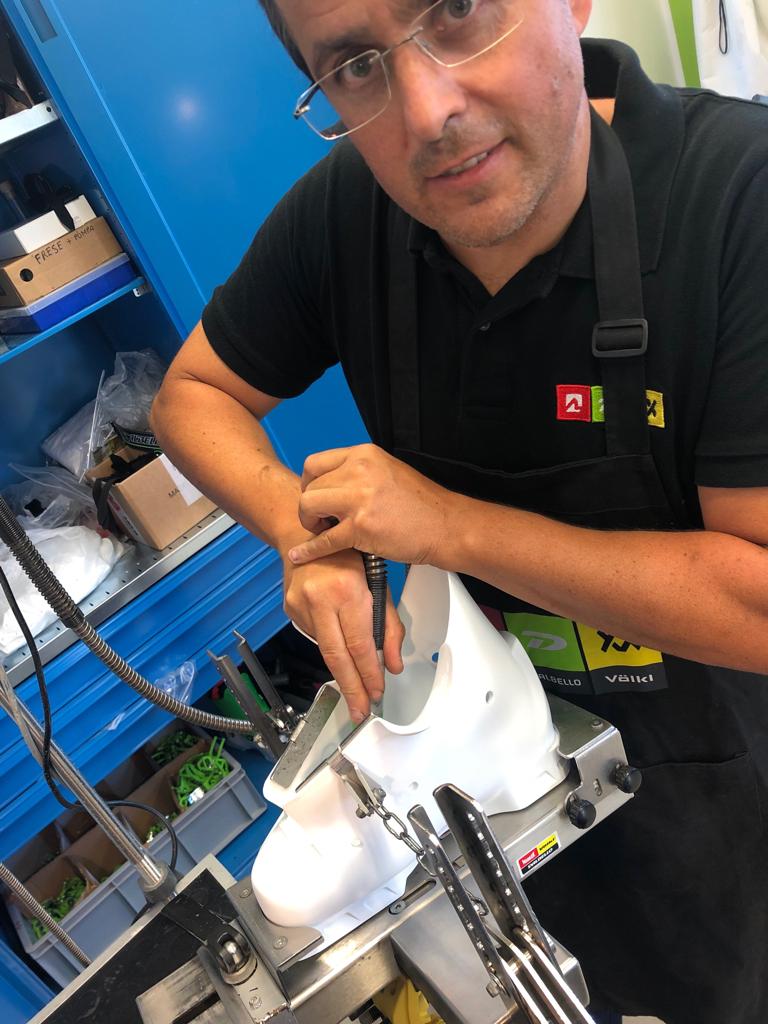
Florian Watschinger hard at work in the boot room.

“I understand the idea behind it,” noted Watschinger. “But it obviously doesn’t translate to snow. On skis this does not play out as an advantage and it seems it hasn’t established itself; in Europe I don’t see this at all.”

According to him, the edging of the boot within the World Cup athletes he works with is done, for the most part, equally on the left and right foot.

Currently, many athletes within the technical disciplines tend to use a smaller sized boot than a typical skier would. Watschinger can also help athletes find up to between five and seven extra millimeters in length to their boot shells thanks to punching, grinding, and other techniques. Foaming liners is a specialty process and something not everyone likes, but he says most athletes prefer a little bit of form-fitting in their liners.

Given all of the different things that can be changed with boots, Watschinger says that probably the biggest thing to play with in boot tuning is the boot board. In particular, how it’s manipulated is different depending on the discipline the boot will be used for.

In speed events like downhill, you want your boot to be less aggressive. Therefore, it’s common to use the original boot board, which is relatively flat. In giant slalom, on the other hand, things look pretty much the opposite. Often Watschinger sands the board down and then puts some 3-5 millimeter plates underneath the boot to create different ramp angles.

Watschinger also notes that it’s easy to forget that every skier needs to adapt to a new boot set up and therefore it is necessary to give the tuned equipment time before it’s evaluated and possibly changed again. Of course, this is different if your feet are in pain. Watschinger always supports shaping the boot so you are pain free.

Through years of experience, Watschinger has gained confidence in his trade, but early on, it was a different story. Very early in his career he was sent to work with Hermann Maier and he thought if he did something wrong it might be the end of his career as a boot service man.

The appointment with the Austrian great was set up very last minute as a quick solution was needed. Of course this added to his stress level considerably. Once at Maier’s home Watschinger asked him what his favorite boot was or what he preferred in a boot and Maier took him into another room. In the room there was an entire wall stacked up with blue boots, even though at the time Maier was skiing on Atomic. Maier told him Lange boots had always been his favorite and in particular the two boots he used in Nagano and the one he won the overall World Cup with.

Maier talked to him like any other ordinary FIS racer would, which made Watschinger feel at ease. Maier, at the time, was one of the few racers on the World Cup who fiddled a lot with their material.

“I will never forget this visit, and a lot of my self esteem comes from this experience,” claims Watschinger.

Watschinger emphasizes that self esteem is the most important attribute you need to build up as a young skier. Over testing equipment will undermine that; testing is questioning, which can easily lead to doubting your equipment, and worse, your technique. Self esteem is developed when you focus on and improve your technical level of skiing and because of this, you start finally getting the results you train for.

  • Monica Huebner Ski Racing Magazine

Ski Season is Winding Down

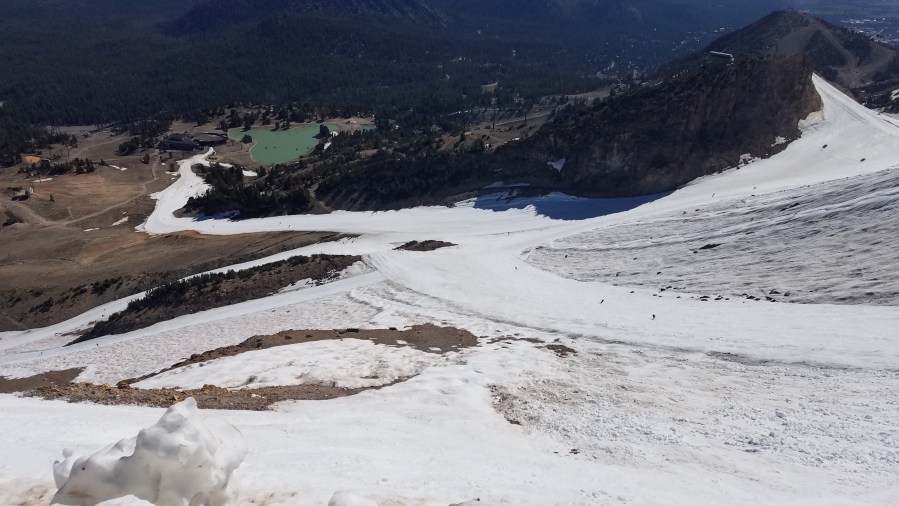
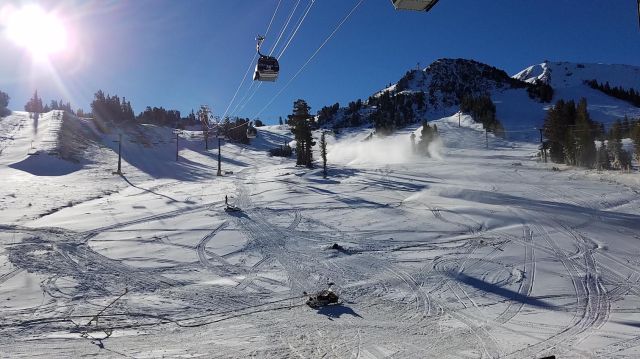
Mammoth’s last day of skiing for this season is Sunday, July 28. Yesterday the skiing was really good first thing in the morning, but was getting pretty soft by 10:30. Plan accordingly and get up early. The picture above is from yesterday (Friday) looking down Cornice Bowl.


For questions or info about real estate in Mammoth

Chris Rees

Coldwell Banker Mammoth

760 914-2657

mammothrealestateforsale.com

reesproperties.com

chris@reesproperties.com

Mammoth Closing Day July 28

*CLOSING DAY ANNOUNCEMENT* The 18/19 season has been one of the best in recent history – endless pow days, wild weather, summer shredding and so many good times on the hill with all of you. Mother Nature has been turning up the heat recently and snow is melting fast – the last day of skiing and riding will be Sunday, July 28. Stay tuned for details on a closing day celebration.

Thanks to EVERYONE that was a part of this season, you made this 260 day 718” season one for the record books.

Get stoked, the 19/20 season kicks off on November 9th!

2016/17 Ski Season Opener


snowmakingHere we go, another ski season is ready to start! Opening day is this coming Thursday, November 10. We had some good storms roll through at the end of October and cold temps for snowmaking and I’ve heard that the upper mountain looks great for opening weekend. The word I got is Mammoth will open with Broadway Chair and Lower, Upper Gondola and maybe Chair 3. Cornice, Climax and Dropout Chutes have been reported as very skiable. Lower down, Broadway will be open. All the usual opening day festivities, $50 lift tickets, beer toast and live music on the sun deck, so come make some turns at the only  ski area open West of Colorado. 


If you’re looking to improve your skiing this season, meet and ski with a new, fun group of people, the Rokka Ski Camp is happening at Mammoth January 6-8, 2017. The camp is open to skiers and boarders, intermediate and above and consists of 3 five hour sessions of free skiing instruction and/or race coaching and video analysis. Happy hour each afternoon. Four to seven students per class. For questions and more info contact Laura Priess at 818 800-3166 or Rokkaracers@aol.com


Here’s a short video on some of the work that goes into getting the mountain ready every season.


See you on the hill, Chris


One Footers for Better Turns

One footers are one of my favorite drills for developing upper level skiers of any age. I also use them for teaching bumps and powder. You can do these on most terrain, but the easier the better to start. I usually start by doing  traverses standing only on the uphill edge of the uphill ski, holding the downhill ski off the snow. This let’s you start getting used to balancing on the little toe side of your foot. It will feel strange! After 4 or 6 of those I start angling the traverse a little more down the hill and finish the traverse with a small turn up the hill to stop. Again, I’m only standing on the uphill edge of the uphill ski. After some more practice, I start trying some shallow turns. Here is where you want to be on very easy terrain. Hands wide for balance and a flexed ankle with pressure against the boot tongue will help a lot! After some practice you’ll be ready to try the advanced version like Bode Miller in the video.

Take your time practicing these and pretty soon you’ll find you can turn left and right standing on either foot. Using more two footed steering, edging and pressure will help your powder and bump turns as well as carving on groomers. Have fun with these and making the jump to expert skiing.

See you on the hill, Chris


Nate Greenberg and the 20-year Transformation from Clueless Amateur to Practiced Backcountery Pro

By Henry Dodge for TGR

Based in Mammoth Lakes, California, Nate Greenberg has been backcountry telemark skiing in the Eastern Sierra for nearly 20 years. He’s skied a lot of gnarly lines and covered an immense range of terrain throughout his time spent exploring and skiing, making him one of the most knowledgeable backcountry travelers in the area. Through his experiences, Nate has made huge contributions to both the Sierra backcountry community and the snow safety community at large, Greenberg co-wrote a comprehensive backcountry guide, Backcountry Skiing California’s Eastern Sierra, that provides people with beta and advice on lines to ski from two Eastern Sierra veterans with years of experience in the region.

Aside from writing, Greenberg also helped found the Eastern Sierra Avalanche Center, in 2006. The Center forecasts avalanche conditions each day and acts as a free platform for people to interact and share their experiences out in the backcountry. ESAC provides forecasts for a huge area of terrain and has become an invaluable resource for backcountry enthusiasts in the Eastern Sierra. TGR caught up with Nate last week to talk about backcountry safety, his personal experiences, and the future of skiing.

What was the motivation for restarting the Eastern Sierra Avalanche Center?

Greenberg exploring the Eastern Sierra backcountry. Dustin Clark/Camelbak photo. 

It’d been about 20 years since there was an avalanche center in the Eastern Sierra and there was very limited snow safety information out there for backcountry users in the area. We felt the need to get the center operational again and felt that it could really provide backcountry skiers and snowboarders with the information they needed to make good decisions while traveling in avalanche terrain.

Our goal today is to act as a clearinghouse of information. We’re essentially a common resource which users can rely upon both to contribute data and have conversations with other users. We are also an authoritative source for snowpack and avalanche conditions in the Eastern Sierra. Since 2006, the center has spawned some really healthy and important decision-making factors in the community which we hope will continue.

Was there a catalyst that made you think the avalanche center was a necessity?

Nate looking out at an view in the backcountry. Dustin Clark/Camelbak photo.

I think the most striking moment for me was the third fatality in the Eastern Sierra during a 15 year stretch. Three off-duty ski patrollers, all of whom were good friends of mine, triggered a slide while skinning up Mt. Walt in the Bridgeport area. It was one of those ‘wrong-place, wrong time’ situations. A lot of wind had loaded that slope from the day before from a large fetch that was over a ridgeline that they couldn’t see.

It wasn’t a very big slide, but big enough to knock them off their feet. One was lucky enough to grab onto a tree and let the slide pass. One was carried through open terrain and partially buried with a head injury, and one dragged through a bunch of trees, which caused enough trauma to ultimately kill her.

It was a pretty chilling experience because it made us realize that there was a lot more going on out there than many of us considered. I look at a lot of other incidents that have happened in the Eastern Sierra over the years, even if they didn’t result in fatalities, and they’re very similar to that avalanche in 2006. The wind is a big factor for us. That incident really shook the community and left a lasting impression on me personally.

What’re the goals for the ESAC?

Greenberg and friends skinning up a mountain. CamelBak / Dustin Clark photo.

One of the main goals this year has been to get more people interacting with the Center. The core area that the Center forecasts for is between Lee Vining and Bishop–roughly a 90 mile stretch along Highway 395. It’s a huge territory, and with two forecasters, the only way we can effectively cover the entire area is to get good data and involvement from the community itself. We really have been pushing to get folks to contribute data by posting observations to the site or even less formally by having discussions online about what they’re seeing out there.

How has the job of the avalanche center changed this season with the El Niño winter?

Greenberg looking at some untouched pow! Dustin Clark/Camelbak photo. 

I think once we see the El Niño really turn on for us, the biggest thing that we’re going to be focusing on is that after 4 years of drought, people are jonesing and will want to go ski big lines that they haven’t been able to ski. A big change and focus for our forecasters is going to be really driving that awareness, so when a bunch of these shallow snowpack areas get a bunch of snow on them, people understand the risks and what could happen. In most areas, there is still less than a foot of snow on the ground, which is creating more of a Continental-like snowpack. Most backcountry users in the Eastern Sierra aren’t used to persistent and buried weak layers. So once El Niño starts to throw on a lot of load on these slopes with new snow, how’s that going to impact future stability? More importantly, are people going to be able to asses the conditions adequately?

How’s the Sierra snowpack different from other popular backcountry destinations? What makes it unique?

Shredding freshies in the backcountry. Dustin Clark/Camelbak photo.

For folks who haven’t been to the Eastern Sierra, we generally refer to it as the region between Bridgeport to just south of Lone Pine. That couple hundred miles is pretty unique compared to the rest of the Sierra in that it’s quite steep and has a huge elevation range, with Death Valley being the lowest point in the continental U.S. and Mt. Whitney being the highest, both within roughly a hundred miles of each other. The other thing that’s really unique about the region is the way the range is set up and the way the drainages more or less cross-cut it.

It’s predominantly a north-south running range with east-west running drainages. There are summer roads in almost every one of these drainages that head west from Highway 395. This gives the region a lot of really diverse terrain and there’re huge opportunities for ski touring and ski mountaineering between tree skiing in the lower elevation areas to high altitude opportunities on the 14’ers, and all within roughly 200 miles of each other.

How has your view of backcountry safety progressed during your time in the backcountry?

Nate surveying lines in the Eastern Sierra. Dustin Clark/Camelbak photo.

When I first started skiing in the backcountry, I obviously didn’t know anything and was kind of just poking around. There was a motivation to get away from the ski area and get away from people. I was aware that there was avalanche risk, but none of it really made sense to me.

Things really started to change for me in 2000 when I took a professional level 2 course taught by Ian McCammon and Don Sharaf. That course opened my eyes to the potential out there and in many ways it was those guys who inspired me to look at not only backcountry safety, but that experience also planted the seed for the beginning of the avalanche center and in some ways even writing the ski guide.

In terms of equipment, clearly the overall industry trend of equipment evolution and change has opened up opportunities for more people to get into the backcountry, and it’s made it easier and more enjoyable. You start to bring the airbag thing into the conversation, and that starts to change things. I think there’s this perception that “I’ve got this thing on my back and if something goes wrong it’s going to save me.”

I personally look at beacons and airbags very similarly, because by the time you have to think about using either one, something is very wrong that should have been avoided in the first place.

Is there anything lacking in the backcountry community in terms of safety?

Nate and friends skiing untouched pow. Dustin Clark/Camelbak photo.

I wouldn’t say there’s necessarily anything lacking, but there’s no replacement for taking a true avalanche course and having a mentor. Mentorship was one of the things that I sort of lacked during my skiing career, and it wasn’t until I had a few key people put me under their wing that everything started to make sense. I think that those of us who have been skiing in the backcountry for a long time or have experience in a certain range know that there’s a lot of opportunity for people to really impart knowledge on up and comers.

There’s a lot of excitement out there in the community and obviously the industry as a whole is trending more towards backcountry. And people should understand what it means to take that on. Not just going out and buying a handful of different avalanche tools and assuming that they’re good to go. It’s scary to see the number of avalanche deaths of skiers and snowboarders rise. I think that there needs to be a lot of emphasis put on the path towards becoming aware and educated and able to make good decisions on your own while traveling in avalanche terrain.